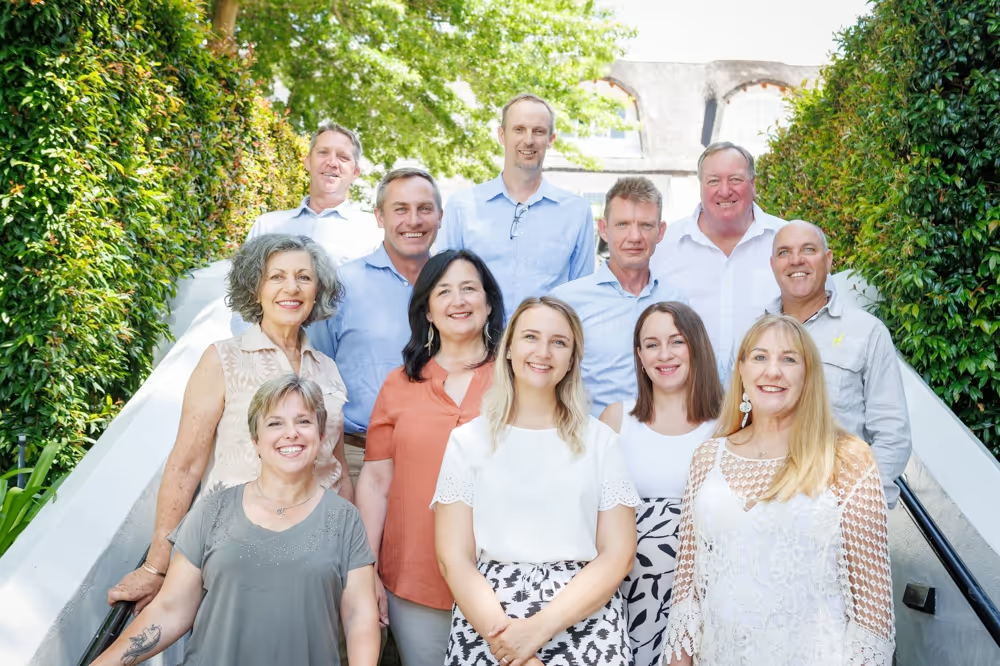
Tourism That Cares Collection consists of a vibrant, experienced team of travel specialists, based at our Head Office in Cape Town, South Africa, as well as a senior person in Johannesburg, plus two offices along the Garden Route in the Western Cape.
General

Biometrics refers to any personal biological data that is captured, usually in the form of fingerprints or a photograph. When submitting an application at a South African Mission abroad, 2 passport-sized photographs should always accompany your application. The Mission might require you to give fingerprints upon submission as well. When submitting a visa application in South Africa, your fingerprints and photo are taken electronically at the submission centre, so there is no need to obtain it beforehand.
https://www.savisas.com
An unabridged birth certificate (UBC) is an extended birth certificate that provides the details of both biological parents of the holder. Whenever a birth certificate is required for visa or permit purposes, a certified copy of your UBC will always be applicable.
https://www.savisas.com
Take medium warm jackets, even a medium rain jacket, cotton trousers, for the early morning and late afternoons, as you may receive experience afternoon thundershower or two. Dress in layers especially for your morning activities, as once the sun hits around 9 am, it can warm up appreciably. Sunhats, sunglasses and sun block are always advisable during the course of the day.
Bring along a good camera, spare batteries and chargers. Essentially plan for having a set of batteries charging in your room during the day. Set out on safari with one set in camera, plus a spare set in your hand luggage.
AMEX is not a widely accepted credit card in Africa. MasterCard and Visa are widely accepted. Bring at least USD 250 in cash (in small denominations, as change is not readily given) per person for restaurant tipping (10%), entrance fees and personal purchases from local markets that may not take cards.
If you have any personal medication that you need, we suggest bringing a good supply, as local pharmacies may not stock your specific brand of medications. A good form of probiotics may help with adjusting to the local food and water, as your jet-lagged ammune system might need to adjust.
Economy Class:
Checked baggage: 1 piece, up to 20 kg
Hand baggage: 1 piece, up to 7 kg
All luggage must be lockable
Business Class:
Checked baggage: up to 2 pieces, total weight not exceeding 32 kg
Hand baggage: 1 piece, up to 7 kg
All luggage must be lockable
Insurance & Visas
Visas for South Africa: Please click on the link below.
https://www.dha.gov.za/index.php/countries-exempt-from-sa-visas
For any of the other countries to which we offer tours, please liaise directly with our expert travel consultant, who will advise you accordingly.
We strongly advise that you take out comprehensive travel insurance covering yourself for personal effects, personal accident, medical and emergency travel expenses, cancellation and curtailment as well as medical evacuation by airlift, in case you are in a remote area.
Some countries are deemed visa exempt, which means visitors from there, will be granted a tourist visa valid for up to 90 days when entering South Africa. If you are not from a visa exempt country or you would like to visit our country for any reason other than tourist-related activities, you will need to apply for the appropriate visa at the relevant South African mission in your country or for your state. In order for us to assess which visa would be best suited for you, fill in the quick request and we’ll get back to you with a free no-obligations quote.
https://eta.dha.gov.za/
https://www.savisas.com
Yes, all visa applications have to be submitted in person as per the new visa regulations (ETA) that came into effect in 2025. If there is no formal South African representation in your country by means of an established mission, jurisdiction over your region will have been allocated to a nearby mission.
https://eta.dha.gov.za/
https://www.savisas.com
Requirements
Passports: It is a mandatory requirement that you travel to South Africa with at least two blank passport pages per country visited and that your passport is valid for a minimum of 6 months after date of travel. If there is insufficient space in the passport then entry into a country could be denied.
South Africa, Namibia and Botswana, have large portions of the country that do not require Malaria precautions. However there are parts in each country which are in the low lying areas that do not experience frost, and are definitely malaria areas. Kindly refer to our 'Before you travel document' which will be sent to you once you have booked, and chat to your consultant for up to date advice regarding Yellow Fever, Tetanus, Hepatitis etc. For further information, consult this guide.
Make certified copies of important documents like passports and flight tickets, and keep these separate from your original documents in case of emergency / loss of documents.
According to the new immigration regulations, a police clearance is required for all visa applications for a stay longer than 3 months.
https://www.savisas.com
The general rule is that a certified copy is submitted in the case where the document does not have an expiry date and is too valuable to lose, e.g. an original marriage certificate or an original birth certificate. Since the Department of Home Affairs does not return your submitted documents after a submission, it is advised that you submit a certified copy in these instances. However at all times, your original medical report, radiological report and police clearance certificates have to be submitted with all applicable applications.
https://www.savisas.com
A certified copy is a stamped photocopy of any document which simply confirms that the photocopy is identical to the original. In South Africa, this is done free of charge by a Commissioner of Oath (a lawyer, a magistrate, a police officer, etc.) by presenting both the original and the photocopy to the Commissioner. In some countries where this is not common practice, the South African mission is often able to certify documents or alternatively a notary will be able to provide this service.
https://www.savisas.com